
October 23, 2026
A practical guide for founders and small teams on building a simple, AI assisted support system without hiring a dedicated support department.
Anablock is a technology and AI systems company helping businesses automate workflows, connect tools, improve lead handling, and build smarter digital growth systems. The Anablock team writes about AI implementation, automation, CRM, lead generation, SEO/AEO, and practical ways businesses can use technology to operate better and grow.
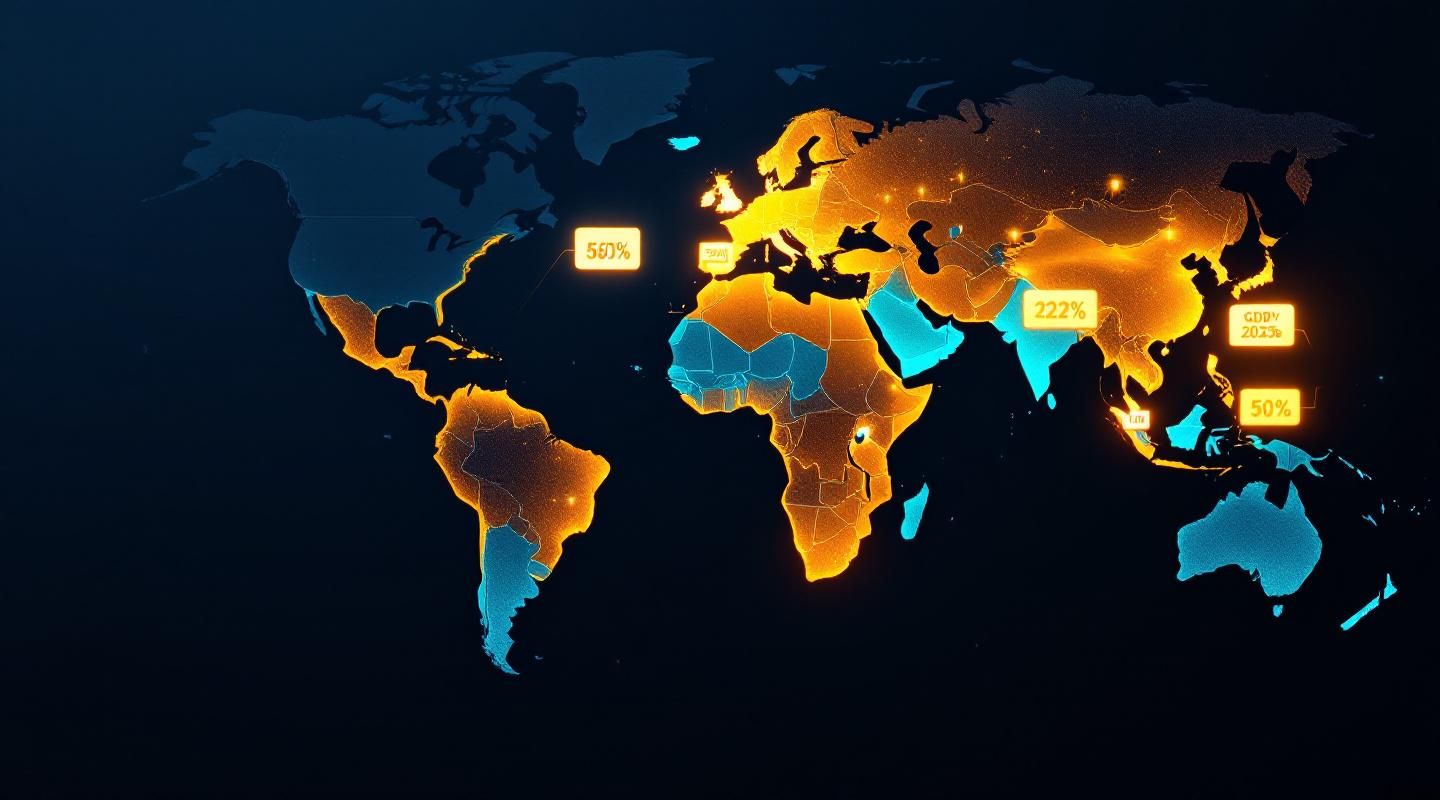
The global economic landscape is shifting — and emerging markets are leading the charge. While developed economies struggle with sluggish growth averaging just 1.8%, emerging market and developing economies (EMDEs) are projected to expand at 4.2% in 2025, outpacing the rest of the world by a significant margin.
But not all emerging markets are created equal. From South Asia's explosive momentum to Latin America's persistent underperformance, the divergence between regions has never been more pronounced. Here's what the latest World Bank and IMF data tells us about where the world's fastest growth is happening — and why it matters.
South Asia is the fastest-growing emerging market region on the planet, and it's not particularly close.
Driven almost entirely by India's remarkable 7.2% GDP growth in FY2025, the region is expanding at more than double the global EMDE average. India is now adding more GDP annually than most entire emerging market regions combined — a staggering feat for an economy already exceeding $3.5 trillion.
Bangladesh and Sri Lanka are also contributing positively, with both economies recovering strongly from recent turbulence. The World Bank projects South Asian growth to remain elevated at approximately 6.5% through 2027, supported by firming domestic demand and recovering export activity.
Key caveat: Strip out India and Bangladesh, and regional growth falls to around 3.6% — the headline number is heavily India-dependent.
Why it matters: South Asia represents the single most compelling growth story in the global economy today. Businesses targeting high-growth markets should treat India as a top-priority expansion destination.
Sub-Saharan Africa may not be growing as fast as South Asia in absolute terms, but it holds a crucial distinction: it received the most significant upward revision of any EMDE region in the IMF's January 2026 World Economic Outlook update.
The IMF now forecasts 4.4% growth in 2025, accelerating to 4.6% in 2026 — revised upward at a time when most other regions were revised down. This signals genuine structural improvement, not just cyclical bounce.
Key drivers include:
South Africa remains a drag on the regional average at just 1.4% growth, but the broader continent narrative is increasingly positive.
Why it matters: Sub-Saharan Africa is the long-term emerging market opportunity. The upward revision trajectory, combined with a young and rapidly urbanising population of 1.4 billion, makes this the highest-upside region for patient capital.
MENA doesn't generate the same headlines as South Asia or Africa, but it offers something arguably more valuable: stability with growth.
Gulf states — Saudi Arabia, UAE, and Qatar — are executing ambitious economic diversification programmes (Vision 2030, UAE Centennial 2071) that are creating entirely new demand pools in technology, financial services, tourism, and infrastructure. Egypt is stabilising under its IMF programme, and the broader region is projected to accelerate from 3.6% in 2026 to 3.9% by 2027.
Why it matters: MENA is an underappreciated B2B opportunity. Government-led transformation programmes are generating significant procurement activity across tech, consulting, and professional services.
East Asia and Pacific remains a large and important region, but the growth story is decelerating. China's structural slowdown — driven by property sector stress, demographic headwinds, and trade tensions — is dragging the regional average down.
Bright spots include Vietnam, the Philippines, and Indonesia, all of which continue to attract manufacturing investment as supply chains diversify away from China.
Why it matters: The China slowdown is real and structural. Investors and businesses should look to ASEAN nations as the next wave of East Asian growth rather than betting on a Chinese rebound.
Latin America holds the unfortunate distinction of being the slowest-growing EMDE region in 2025–2026. At just 2.0–2.3% growth, it barely outpaces developed market averages and significantly underperforms the broader EMDE universe.
Brazil and Mexico face persistent structural challenges: fiscal pressures, commodity price sensitivity, and political uncertainty. The World Bank projects only modest recovery to 2.6% by 2027.
World GDP reached $111 trillion in 2024, recovering strongly from the COVID-era contraction. Emerging markets — representing approximately 45% of global GDP — are projected to grow their collective economic output from roughly $51.5 trillion in 2026 to $58.5 trillion by 2030.
The emerging market growth story is alive and well — but it's increasingly concentrated. South Asia leads by a wide margin, Sub-Saharan Africa is accelerating, and MENA offers stable, policy-driven opportunity. Meanwhile, East Asia is moderating and Latin America continues to disappoint.
For businesses, investors, and policymakers, the message is clear: the next decade of global growth will be written in the Global South — and the organisations that position themselves now will be best placed to capture it.
Data sources: World Bank Global Economic Prospects (January 2026), IMF World Economic Outlook Update (January 2026), FRED/World Bank World GDP Series, TAM MCP forecasting engine.
Written by
AI Insights & Innovations
Anablock is a technology and AI systems company helping businesses automate workflows, connect tools, improve lead handling, and build smarter digital growth systems. The Anablock team writes about AI implementation, automation, CRM, lead generation, SEO/AEO, and practical ways businesses can use technology to operate better and grow.


If you are ready to move from research to implementation, we can help map the right AI system around your tools, data, team, and goals.