Case Study - How We Built a Connected Patient Acquisition System for a 7-Location Dental Group
A complete patient acquisition and operations ecosystem connecting paid media, conversion-focused websites and landing pages, lead qualification, CRM, AI automation, real-time scheduling, and existing practice systems across seven dental locations.
- Client
- Streamline Dental - Multi-Location Dental Group
- Year
- Service
- AI-Powered Patient Acquisition & Growth Infrastructure
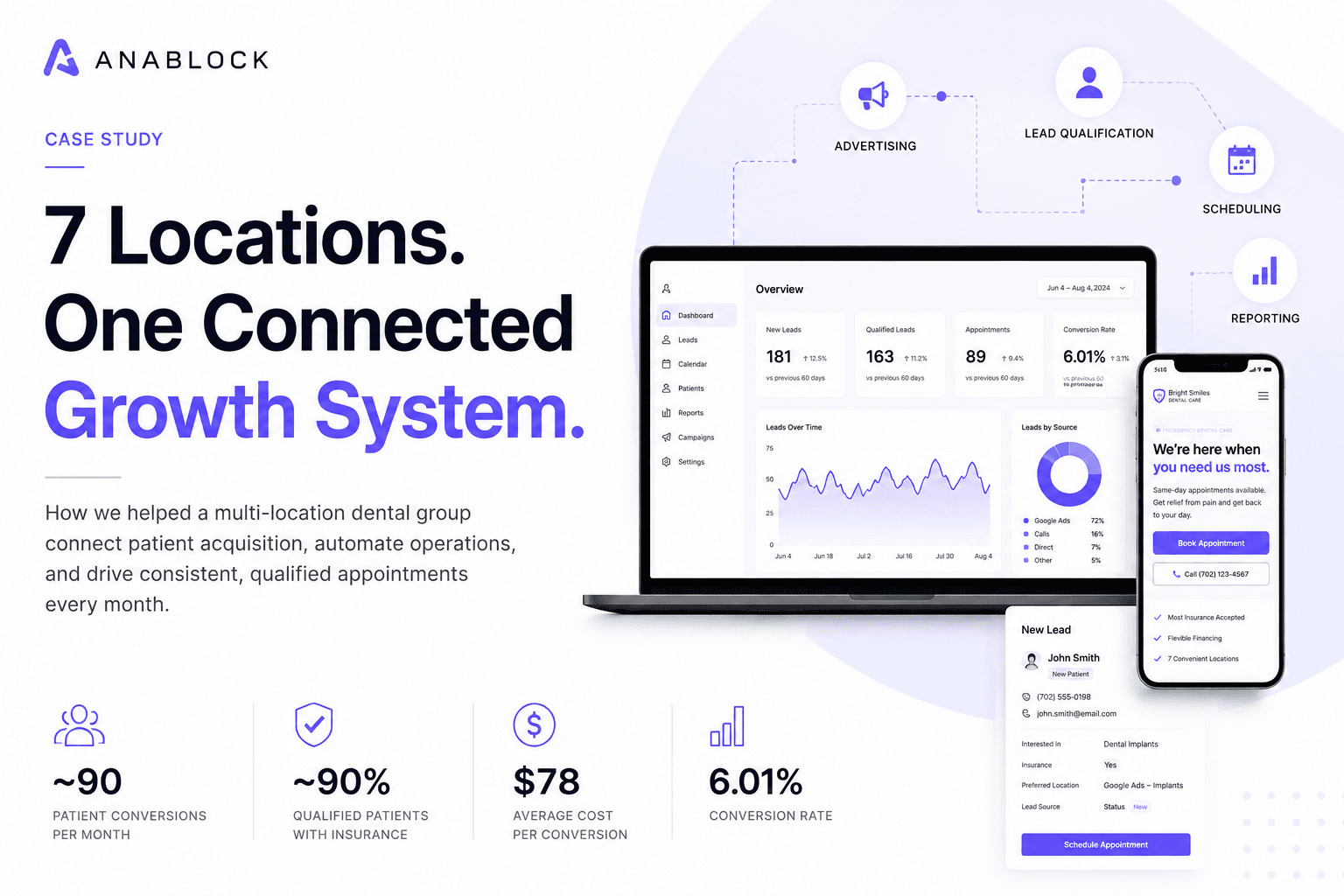
Overview
From fragmented marketing and manual workflows to a connected growth infrastructure generating consistent patient demand across seven practices.
7 Locations
~90 Patient Conversions / Month
~90% of Qualified Patients Report Insurance
$78 Average Cost per Conversion
Executive Summary
Growing a dental organization across seven locations creates a problem that more advertising alone cannot solve.
More campaigns create more inquiries. More locations create more scheduling complexity. More software creates more data. And when marketing, websites, CRM, scheduling, patient communication, and practice systems operate independently, growth creates operational friction instead of eliminating it.
That was the challenge we set out to solve.
Anablock worked with a seven-location dental organization to build a connected patient acquisition infrastructure spanning the entire journey from the first patient search to lead qualification, appointment scheduling, follow-up, and performance reporting.
We didn't simply optimize advertising.
We connected the organization's website, campaign landing pages, paid acquisition, CRM, AI automation, real-time scheduling, communication workflows, analytics, and existing systems into one coordinated ecosystem.
The result is a system currently generating approximately 90 patient conversions per month from Google Ads alone, while simultaneously qualifying incoming opportunities, identifying insurance status, routing patients into the appropriate workflows, and giving the organization significantly better visibility into what happens after a lead is generated.
The Challenge: Growth Was Happening Across Disconnected Systems
The organization already had many of the components required for growth.
They had multiple established locations.
They had staff.
They had marketing.
They had existing technology.
They had systems for managing patients and appointments.
The problem was that those components weren't designed to operate as one system.
A prospective patient could click an advertisement, visit the website, submit an inquiry, enter one system, require manual follow-up from another team, schedule through another process, and ultimately become disconnected from the original marketing source that generated the opportunity.
At seven locations, those gaps compound quickly.
The challenge wasn't simply:
How do we generate more leads?
It was:
How do we build an infrastructure capable of acquiring, qualifying, routing, scheduling, tracking, and following up with patients consistently across seven locations?
That required approaching growth as a systems problem rather than a marketing problem.
The Solution: One Connected Dental Growth System
We designed the infrastructure around the complete patient journey.
Instead of treating the website, advertising, CRM, scheduling, AI, and existing practice technology as separate projects, we connected them into a single operating system for patient acquisition.
Patient Demand
      ↓
Google Ads + Organic Search
      ↓
Website + Dedicated Landing Pages
      ↓
Calls + Forms + Patient Inquiries
      ↓
Lead Qualification & Categorization
      ↓
CRM
      ↓
AI-Powered Workflows
      ↓
Real-Time Scheduling
      ↓
Existing Practice Systems
      ↓
Automated Follow-Up
      ↓
Tracking + Reporting
Each component has a specific purpose.
More importantly, each component shares information with the next.
01. Building the Patient Acquisition Engine
The first layer of the system was predictable patient demand.
Instead of running broad campaigns that treated every search the same way, we structured acquisition around patient intent.
Campaigns were developed for high-value and high-intent categories including:
- Dental implants
- Emergency dentistry
- Insurance-based searches
- General dental services
- Spanish-speaking patients
- Branded searches
- Location-specific demand
This allowed us to control messaging, budget allocation, landing experiences, and conversion strategy based on what a patient was actually looking for.
Current Google Ads Performance
Across the two-month reporting period analyzed, campaigns produced:
| Metric | 2-Month Performance | Approx. Monthly Average |
|---|---|---|
| Impressions | 24,025 | 12,013 |
| Clicks | 2,898 | 1,449 |
| Primary Conversions | 181 | ~90 |
| Conversion Rate | 6.01% | 6.01% |
| Cost per Conversion | $78.04 | $78.04 |
| Advertising Spend | $14,124.98 | ~$7,062 |
These are not results from a short-lived campaign spike. They reflect the current steady-state performance of an acquisition system that is continuously managed and optimized.
02. Matching the Experience to Patient Intent
Generating a click is only the beginning.
Sending every prospective patient to the same generic page would mean ignoring one of the strongest signals available: what that patient searched for.
We created dedicated conversion paths based on service, insurance, urgency, campaign, and patient intent.
That included a combination of:
- Conversion-focused landing pages
- Service-specific pages
- Insurance-specific experiences
- Emergency dental journeys
- Mobile-first conversion paths
- Localized content
- Clear appointment actions
- Trust and credibility elements
- Conversion tracking across key interactions
A patient searching for emergency treatment should not experience the same journey as someone researching dental implants.
A patient looking for a dentist who accepts their insurance needs different information from someone comparing restorative treatment options.
The website and landing page ecosystem was therefore built around intent rather than a one-size-fits-all funnel.
03. From Lead Generation to Patient Qualification
Generating more inquiries is useful only when the practice can understand which opportunities are coming in and what they need.
This is where the system moves beyond traditional digital marketing.
Incoming patient inquiries are qualified, categorized, and prioritized based on the information available.
Instead of handing the office a list of names and phone numbers, the system can help identify important patient characteristics and intent, including:
- Service needed
- Location preference
- Insurance status
- Urgency
- Source
- Campaign
- Stage in the patient journey
- Required next action
This gives staff significantly more context before they engage with the patient.
It also creates better data for automation and reporting.
~90% of Qualified Patients Report Having Insurance
One of the most important findings from patient qualification is the quality of the demand being generated.
Approximately 90% of qualified patient inquiries report having dental insurance.
For a dental organization, this is a critical distinction.
Lead volume alone tells very little about the commercial quality of patient acquisition.
A system generating large numbers of low-intent or poorly matched inquiries can look successful in an advertising dashboard while creating very little value for the practice.
By capturing qualification data after acquisition, we can evaluate more than the number of leads.
We can understand who those prospective patients are.
This allows the organization to evaluate marketing performance using patient-level signals rather than relying exclusively on clicks and form submissions.
04. Centralizing Patient Opportunities in the CRM
Once an inquiry is captured and qualified, the information needs somewhere to go.
We connected patient acquisition with a centralized CRM designed to provide visibility across the lead lifecycle.
Instead of information living independently inside advertising platforms, forms, inboxes, spreadsheets, and other tools, the CRM becomes the operational layer connecting acquisition with follow-up.
Depending on the inquiry, the organization can track information such as:
- Patient contact information
- Lead source
- Campaign
- Service interest
- Insurance information
- Preferred location
- Lead status
- Communication history
- Appointment status
- Follow-up activity
This creates a shared view of patient opportunities across the organization.
Marketing knows what it generated.
Operations knows what requires action.
Management gains visibility into what happens after the initial conversion.
05. Connecting the Existing Technology Stack
Replacing every piece of existing software is rarely the right answer.
Dental organizations already rely on systems that are embedded deeply into daily operations.
Our approach was therefore not to force the practice into an entirely new technology stack.
Instead, we built the integration layer around the systems they already used.
The new acquisition infrastructure connects with existing tools and workflows wherever possible, allowing data to move between marketing, CRM, scheduling, communication, and practice operations.
This was a critical part of the implementation.
The goal wasn't to add more software.
The goal was to make the existing and new technology work together.
06. Real-Time Scheduling
Speed matters significantly in patient acquisition.
A high-intent patient searching for emergency dentistry, an implant consultation, or a dentist accepting their insurance may contact several practices within a short period.
Traditional workflows create unnecessary delays:
Patient submits inquiry
        ↓
Inquiry waits
        ↓
Staff reviews it
        ↓
Staff attempts contact
        ↓
Patient responds
        ↓
Availability is checked
        ↓
Appointment is scheduled
We reduced that friction by connecting patient acquisition with real-time scheduling workflows.
The objective is to move the patient from interest to appointment as quickly as possible while keeping the appropriate practice systems and staff involved.
That means fewer unnecessary handoffs and less dependence on manual administrative work.
07. Adding AI and Automation Across the Patient Journey
AI wasn't implemented as a standalone chatbot or novelty feature.
It became an automation layer across the growth system.
AI and automated workflows help process information, trigger actions, update systems, and reduce repetitive administrative work.
Depending on the workflow, automation can support:
- Patient inquiry processing
- Lead qualification
- Lead categorization
- Routing
- CRM updates
- Internal notifications
- Follow-up sequences
- Email communication
- SMS workflows
- Appointment workflows
- Conversation processing
- Reporting and operational tasks
The objective is not to remove staff from the patient experience.
It is to remove unnecessary administrative work around that experience.
Staff can spend more time interacting with patients while the infrastructure handles repetitive processes in the background.
08. Creating a Closed-Loop Growth System
Traditional marketing reporting often ends at a conversion.
We wanted the system to go further.
AD SPEND
    ↓
PATIENT INQUIRY
    ↓
QUALIFICATION
    ↓
CRM
    ↓
APPOINTMENT
    ↓
PATIENT
    ↓
PERFORMANCE DATA
    ↺
CAMPAIGN OPTIMIZATION
The more information that flows back through the system, the better decisions we can make about acquisition.
Instead of asking:
Which campaign generated the cheapest leads?
We can begin asking much more valuable questions:
Which campaigns generate the right patients?
Which services produce the strongest demand?
Which locations need additional acquisition?
What percentage of inquiries have insurance?
Which patient segments move successfully toward appointments?
Where are opportunities being lost?
That changes how marketing decisions are made.
Results by Campaign
Different campaigns were designed around different types of patient demand.
| Campaign | Impressions | Clicks | Conversions | Conversion Rate | Cost / Conversion |
|---|---|---|---|---|---|
| Implants | 14,728 | 1,437 | 70 | 4.52% | $64.22 |
| Emergency Dentistry | 2,719 | 425 | 55 | 12.94% | $62.06 |
| Insurance | 4,435 | 586 | 46 | 7.85% | $109.03 |
| Spanish Search | 1,697 | 326 | 7 | 2.15% | $139.40 |
| Brand | 446 | 124 | 3 | 2.42% | $74.99 |
The numbers also reveal something important about the strategy.
Implants and emergency dentistry alone generated 125 primary conversions during the reporting period.
These aren't passive awareness campaigns.
They target patients actively searching for dental treatment.
The Impact Goes Beyond 181 Conversions
The most important outcome of the project isn't a single advertising metric.
It's the infrastructure behind it.
The practice now has a system designed to continuously:
Attract demand
Capture patients actively searching for dental care.
Convert demand
Direct patients into experiences built around their specific intent.
Understand demand
Qualify and categorize inquiries instead of treating every lead equally.
Act on demand
Route information into CRM, scheduling, staff, and automated workflows.
Measure demand
Connect patient acquisition data with the systems responsible for handling it.
Improve continuously
Use what happens downstream to make better acquisition decisions.
What Consistent Performance Looks Like at Scale
The current system generates approximately:
~90
Google Ads Conversions Every Month
~1,450
High-Intent Ad Clicks Every Month
~12,000
Search & Campaign Impressions Every Month
~90%
Qualified Patients Reporting Insurance
7
Locations Operating Within the Connected Growth Infrastructure
The value isn't simply that these numbers can be achieved.
It's that the infrastructure is designed to produce, process, and learn from this demand consistently across multiple locations.
From a Marketing Funnel to Growth Infrastructure
Before the implementation, individual systems handled individual parts of the patient journey.
After implementation, those components became part of one connected infrastructure.
| Traditional Setup | Connected Growth System |
|---|---|
| Advertising generates leads | Acquisition generates trackable patient opportunities |
| Generic website traffic | Intent-specific conversion experiences |
| Raw leads | Qualified and categorized patient inquiries |
| Manual lead handling | Automated routing and workflows |
| Separate scheduling | Real-time scheduling integration |
| CRM as a database | CRM as an operational layer |
| Disconnected software | Integrated existing and new systems |
| Marketing reports | Full-funnel performance visibility |
| Manual repetitive work | AI-assisted automation |
| Individual location processes | Scalable infrastructure across 7 locations |
Why This Approach Works for Multi-Location Dental Organizations
The complexity of a dental organization doesn't grow linearly.
Every additional location introduces more campaigns, more staff, more patients, more scheduling variables, more reporting, and more opportunities for information to fall between systems.
Simply increasing advertising spend doesn't solve that problem.
In many cases, it makes the problem larger.
The infrastructure behind acquisition needs to scale with demand.
That's why our work focused on connecting four fundamental layers:
Acquisition
Creating predictable patient demand.
Conversion
Turning that demand into patient inquiries.
Operations
Qualifying, routing, scheduling, and managing those opportunities.
Intelligence
Using data and AI to understand performance and continuously improve the system.
When those layers work together, marketing stops operating as an isolated department.
It becomes part of the organization's growth infrastructure.
The Outcome
This project started with a simple objective: improve patient acquisition.
What emerged was much larger.
A seven-location dental organization now operates with a connected infrastructure spanning:
Website → Landing Pages → Paid Acquisition → Lead Qualification → CRM → AI Automation → Real-Time Scheduling → Existing Practice Systems → Follow-Up → Analytics
The result is not simply more leads.
It's a more intelligent way to acquire and manage patients.
Marketing generates demand.
Technology connects it.
Automation acts on it.
Staff receives better information.
Management gains visibility.
And the entire system becomes more valuable as more data moves through it.
Build a Growth System Around Your Practice
If your dental organization already invests in marketing but your website, CRM, scheduling, patient communication, and internal systems still operate independently, generating more leads may not be the highest-leverage next step.
Connecting what happens after the lead arrives often is.
Anablock designs and implements connected AI, automation, CRM, and patient acquisition systems for growing organizations.
What we did
- AI Automation CRM Integration Google Ads Patient Acquisition Lead Qualification Real-Time Scheduling Website Development Landing Page Optimization Conversion Optimization Systems Integration Analytics & Reporting
