

October 23, 2026
A practical guide for founders and small teams on building a simple, AI assisted support system without hiring a dedicated support department.
A small business owner scrolls through yet another headline: "Everyone is using AI now." She runs a ten person logistics company, pays her bills on time, and still writes half her customer emails by hand. Is she behind? Ahead? The honest answer is that the numbers tell a more nuanced story than any single headline, and it is worth looking at them carefully before deciding where you stand.
Here is what recent surveys actually found, not predictions, not vendor hype, just reported results.
Why do these numbers range from 22 percent to 77 percent? Because "use AI" means something different in every survey. Some ask about any use ever, some ask about regular use, some ask whether AI is used in producing goods or services, and some ask specifically about scaled, agentic use. Before you quote a headline number, or worry about one, check what question was actually asked.
The most telling figure might be the gap inside a single survey. Goldman Sachs found 76 percent of small businesses use AI in some form, but only 14 percent have it fully embedded in core operations. That gap, reported in the same January to February 2026 survey, is the real story. Most small businesses have tried AI tools. Far fewer have rebuilt a workflow around them in a way that sticks. It is no surprise that 73 percent of respondents in the same survey said they want more training and implementation resources. Trying a tool and depending on it are two different things, and the gap between them is where most small businesses currently sit.
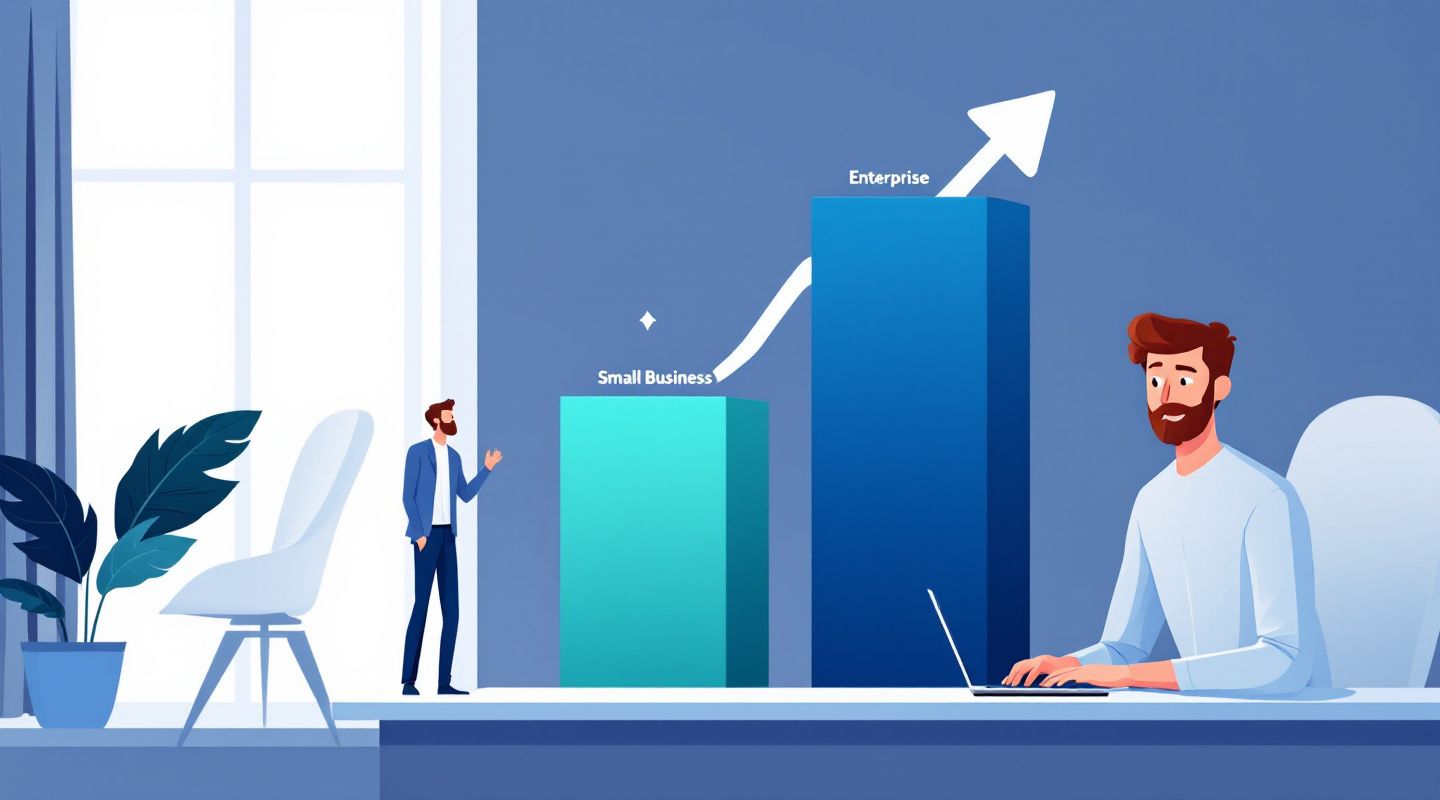
To be fair, large organizations do have an edge in one specific area: scaling AI agents across functions. McKinsey's 2026 survey found 40 percent of large organization respondents were scaling agents in at least one function, up sharply from 27 percent a year earlier, while smaller organizations held steady at 22 percent. Census data tells a similar story by firm size: 36.5 percent of firms with 250 or more employees used AI in the prior two weeks, compared with 23.9 percent of firms with 1 to 4 employees. These are respondent reports, not audited deployment counts, but the direction is consistent.
This is not because the technology is out of reach for small teams. It is more likely a matter of resourcing: enterprises have dedicated AI teams and budgets built for experimentation at scale, while a five person team is often running AI adoption as a side project.
Here is an opinion, not a statistic: smaller businesses may actually be better positioned to close this gap than the current numbers suggest. A ten person company does not need a steering committee to approve a new workflow. One owner can decide on Monday and have a new process running by Friday. Fewer legacy systems mean fewer integration headaches. Shorter approval chains mean faster learning cycles. The advantage enterprises have in scale, small businesses can offset with speed, if they choose to use it.
Anablock builds AI agents for customer support, sales, and lead generation, aimed at exactly this kind of focused, workflow by workflow adoption. The Anablock CRM includes Ana, an AI assistant, and Echo, an AI voice and text agent, so conversations, contacts, and follow ups live in one place instead of scattered across tools. The goal is to help a small team move from trying AI to actually embedding it, without needing an enterprise sized budget or team to do so.
Are small businesses behind enterprises on AI? On scaling AI agents across functions, survey data suggests enterprises are ahead, per McKinsey's 2026 figures. On basic AI use, small business adoption has grown quickly, per Intuit and Goldman Sachs surveys.
Why do adoption numbers vary so much? Because each survey defines "AI use" differently, ranging from any use at all to fully embedded, scaled use. Always check the definition behind the number.
Where should a small business start? With one repetitive workflow, a clear human handoff, and a simple before and after measurement, then expand once it proves out.
If you want to talk through where your business actually sits on this curve, and what a realistic next step looks like, Book a call with Vuk.
Written by


If you are ready to move from research to implementation, we can help map the right AI system around your tools, data, team, and goals.